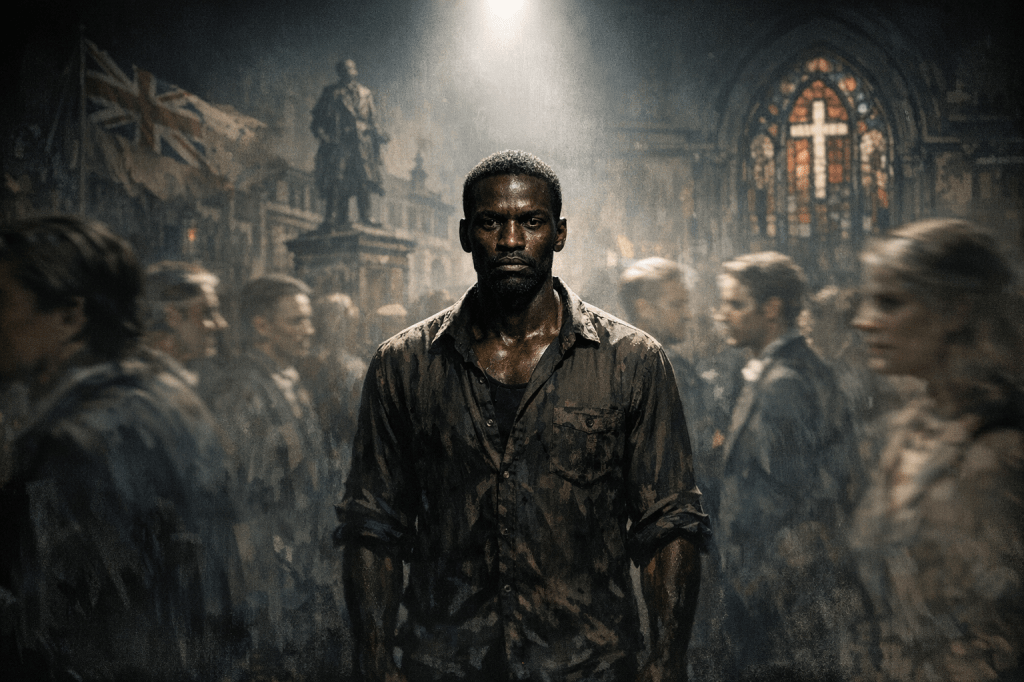
Dear mysterious reader,
You may sense my presence, but my truth drifts in realms your eyes were never meant to follow. And yet, here you are, stepping into the dim corridors of my memory, where shadows speak louder than light and silence has teeth. If you listen closely, you will hear the echoes of a world that began wounding me long before I had the words to name it, a world bent and twisted by racism, shadeism, and the quiet, daily violence of colorism. These are not stories I share for your comfort or understanding. These are stories that demand to be witnessed.
Yes, the world is burning with wars and geopolitical storms. But today I want to speak about a war that is older, quieter, and just as devastating: the war waged against people because of the color of their skin. Color-based discrimination. Shadeism. Racism. Colorism. Black, white, brown, labels we did not choose, but which decide our safety, our dignity, and our chances at simply being human.
In Africa, where I come from, we often call it shadeism and colorism. In America, Europe, and many other parts of the world, the word is racism. The vocabulary shifts with geography, but the wound is the same: a hierarchy built on skin tone, where some are crowned human and others are treated as shadows.
We hear story after story of racial abuse in America, Europe, Asian and Arab countries, videos, headlines, hashtags. But what we rarely hear about is how racism and colorism also live inside African societies themselves. Apart from the obvious cases in the northern parts of the continent, we act as if the rest of Africa is somehow innocent, untouched. It’s a lie we tell ourselves.
The roots are old and deliberate. During colonial rule, skin tone and tribe were used as weapons. Those with fairer complexions were rewarded with easier jobs, better treatment, and a taste of proximity to power. Those with darker skin were pushed into the harshest, most degrading labor. This wasn’t an accident; it was a system—a blueprint for division and control.
What is unforgivable is that this logic still breathes in our so‑called modern, civilized world. Centuries later, many Africans have been conditioned to believe that whiteness or lightness is closer to perfection, intelligence, and authority. We bleach our skins. We straighten our hair. We chase passports from the very nations that once carved us apart. We praise and protect those who look “closer” to white, and we learn to doubt, fear, or mock those who look like us.
I did not learn these rules from a textbook. I learned them through humiliation.
As a child, I was bullied because of my dark complexion. Children threw words at me like stones: charcoal block, night, darkness, anything to remind me I was too black, too different, too wrong. The worst part? The adults laughed. Some joined in. The very people who should have protected me chose entertainment over empathy.
It got so bad that I started skipping school. In class, no one wanted to sit next to me. No one wanted to be seen with me. My existence became something others treated as a stain.
So I did what many of us do: I compartmentalized. I tried to fold the pain into a quiet corner of myself. I tried to accept not just my own face in the mirror, but also the cruelty that followed it. I told myself this was normal, that this was just how the world works.
Fast forward to today. I work in Europe now, and somehow, I am forced to relive my childhood in a different language, under a colder sky. The stares, the assumptions, the jokes dressed up as banter, the way security watches me just a little longer, it’s the same script, just a different stage.
What most people never talk about is the mental toll. The exhaustion. The slow erosion of your sense of worth. Your parents raise you to treat everyone with fairness, humility, and kindness. You’re taught that all humans are equal. Then you walk out into a world that spits that lesson back in your face. Day after day, you are reminded that some lives are cushioned, while others are expected to absorb the blows.
You start to ask dangerous questions: Why is my humanity negotiable? Why is my dignity conditional? Why does the world act like my skin is a problem that needs managing, explaining, or apologizing for? When will this end, and who, exactly, is willing to end it?
The hypocrisy cuts deepest when we look at religion. Around 95% of the world claims some form of faith. We are told, over and over, that we are “created in the image and likeness of God.” Yet some of the loudest voices in racial and color-based discrimination come from the very people who preach that line from pulpits, mosques, temples, and altars.
History is brutally clear: the same powers that colonized, enslaved, and segregated us often came carrying holy books in one hand and chains in the other. They told us they were saving our souls while crushing our bodies. They claimed divine authority while ranking our worth by how light or dark we were.
And that legacy lives on. In our institutions. In our hiring practices. In our prisons and borders. In our dating preferences. In our jokes. In our classrooms and churches and homes. Racism and colorism are not just bad attitudes; they are systems that shape whose pain is ignored, whose death is justified, and whose future is funded.
So here we are, you and I, standing in the dim corridors of memory and history. I am telling you what it means to grow up marked by a color you did not choose and punished for a skin you cannot remove. This is not a request for pity. This is a demand for honesty.
Because until we face the politics of color with the same urgency we claim to have for faith, freedom, and justice, the world will continue to be exactly what it has always been for people like me: a place where we are told we are made in God’s image, but treated as if we are disposable.
And I refuse to be disposable.
And so here we are, in the dim corridors of memory and history, still trying to heal from wounds that were never meant to be seen, yet refuse to remain unseen.
Ever in the unseen,
Guymysterious


Leave a Reply