Kenya, six decades after independence: who really decides?
On 12 December 1963, the Union Jack came down in Nairobi and a new flag went up. A generation believed the hardest part was over. Independence had arrived, and with it, freedom.
Decades later, many Kenyans are asking an uncomfortable question: free from what, and free to do what?
This post argues that Kenya’s freedom is real but incomplete. It is limited by hardship at home and by the pull of powerful outsiders, each of whom wants a piece of the country. Both limits matter.
A Freedom Written on Paper
Kenya has a progressive constitution, a vibrant press, and one of the most active digital communities on the continent. Yet when young Kenyans took to the streets over the 2024 Finance Bill, the Kenya National Commission on Human Rights reported at least 39 people killed and 361 injured. People do not risk that much when they feel heard between elections. The right to vote is not always the same as the power to be heard.
The Economics of Being “Free”
You can’t eat a constitution. For millions of Kenyans, daily life is a calculation of fuel, maize flour, rent, school fees, and electricity, all competing for the same shrinking shilling. Behind that squeeze sits the national debt. Kenya’s total public debt stood at Ksh12.86 trillion at the end of April 2026, made up of Ksh7.19 trillion in domestic debt and Ksh5.67 trillion in external debt. In the first ten months of the 2025/26 financial year alone, Kenya spent Ksh633.08 billion servicing its external debt. Every shilling that goes to a lender is a shilling that does not go to a clinic, a classroom, or a road.
Free From Whom? The Scramble That Never Ended
In 1884, European powers sat at a table in Berlin and divided Africa on a map. Kenya’s independence in 1963 ended the colonial flag, but not the competition. Today the scramble has new players, new tools, and better manners. The weapons are no longer only guns. They are loans, trade deals, security pacts, and conditions attached to money.
Britain: The Landlord Who Never Fully Left
Colonialism did not just rule Kenya; it designed it. The best farmland, the railway lines, the cash-crop economy of tea, coffee, and flowers, and the land title system were built to serve an export economy. Much of that structure survived independence. Land inequality, borders that split communities, and an economy built to export raw goods are all inherited costs. The 2013 settlement paid to Mau Mau victims showed that the injustice was real, and that the acknowledgment came very late. British influence still runs through our legal system, our curriculum, our trade ties, and a military training presence in Laikipia.
America: Ally, and Set of Security Priorities
In 2024, the White House announced that Kenya would be designated a major non-NATO ally, the first country in sub-Saharan Africa to hold the status. Alongside that came a high-profile role in Haiti. Kenya led the Multinational Security Support mission from October 2023, deploying 735 police officers as the backbone of a force of nearly 1,000. But the mission struggled. It was chronically underfunded and never reached its mandated ceiling. It concluded in April, with resources moving to a new force. The governing body of that new force is led by the US and Canada.
The lesson is uncomfortable. Kenya supplied the officers and took the risk, and allegations of sexual violence by members of the mission have clouded its legacy. Meanwhile, the strategic direction sat elsewhere. Add Washington’s weight at the IMF and World Bank, and the conditions that come with their loans, and it becomes fair to ask whose priorities are being served.
China: The Builder, and the Truth About the Debt
The Standard Gauge Railway is the symbol of Chinese influence. The first phase cost US$3.6 billion, 90 per cent of it borrowed from China’s Exim Bank. Kenyans ride it, and many are proud of it. But Kenyan taxpayers spend an average of $7.8 million a month to subsidise it, which makes repayment harder.
The popular story, however, is incomplete. China’s debt stock stood at Sh616.8 billion at the end of June 2026, down from Sh764.2 billion in 2021, and now makes up just 10.8 per cent of Kenya’s Sh5.685 trillion external debt. The World Bank is Kenya’s largest external creditor, owed Sh1.70 trillion, or 29.8 per cent of external debt. The relationship also changed: Kenya converted $3 billion in outstanding Exim Bank loans from US dollars to Chinese yuan. The point is not that one lender is the villain. It is that Kenya owes many hands at once, and each comes with its own terms.
The Gulf and the Arab World: Capital, Labour, and Quiet Influence
The UAE and Saudi Arabia are growing investors, with interests in ports, real estate, and energy. They are also the destination for thousands of Kenyan workers, especially domestic workers, whose reports of abuse show how little leverage Kenya has in protecting its own citizens abroad. When a country exports its people because it cannot employ them at home, that is a sign of dependence, not just opportunity. The older ties along the Swahili coast, from Lamu to Mombasa, add a cultural and commercial layer.
Europe: Trade Terms and Aid Agendas
The European Union is a major market for Kenyan flowers, tea, and coffee, and its trade agreement with Kenya shapes the terms of that exchange. Raw and lightly processed goods flow north, while the higher-value work and jobs of processing and branding happen elsewhere. European aid and NGO funding can strengthen civil society, but can also set agendas that do not originate with Kenyans.
What the Scramble Costs Us
- Politics: When lenders and foreign governments hold leverage, policy can bend toward creditors rather than citizens.
- Economy: Debt service, trade terms, and conditional lending shrink the room to design our own path.
- Social development: Health, education, and food programmes that depend on donors can change with a foreign election.
- Structural development: Roads, rails, and ports tend to move resources out, rather than linking Kenyan towns and industries to each other.
- Growth: Without local value addition, growth benefits those who own the processing, shipping, and finance, rarely the farmer.
The Hard Truth: It Takes Two to Scramble
It would be too easy to blame outsiders alone. No one can take a piece of a country whose own leaders are unwilling to hand it over. Secret contracts, corruption, weak negotiation, and short-term thinking have often made Kenya’s own elite partners in dependence.
Kenya also has agency. It chooses among partners, courts have challenged opaque deals, and the yuan conversion shows that negotiation can win real relief. Foreign investment has built real infrastructure. The question is not whether to engage with the world, but on whose terms.
Climate: The Part Nobody Votes On
Kenya contributes very little to global emissions, yet it swings between drought in the north and destructive floods elsewhere. Most farmers depend on rain, so when the seasons turn unpredictable, so do incomes, food, and school fees. A farmer in Turkana or Makueni cannot be free while his livelihood depends on a climate he did not change. Climate change narrows choices and forces migration, debt, and dependence on aid.
Social Life: Tradition, Pressure, and Change
Kenyan society is rich in community: harambee, extended family, church, and the pull of the rural home. These bonds carry people through hardship, but they also carry weight. The “black tax” of supporting relatives and the expectations placed on those who “made it” can limit personal choice. Young Kenyans are more connected than any generation before, yet often more anxious about work and belonging, and social media shows them the gap between the life they are told to want and the one they can afford.
Real Freedom Means Real Bargaining Power
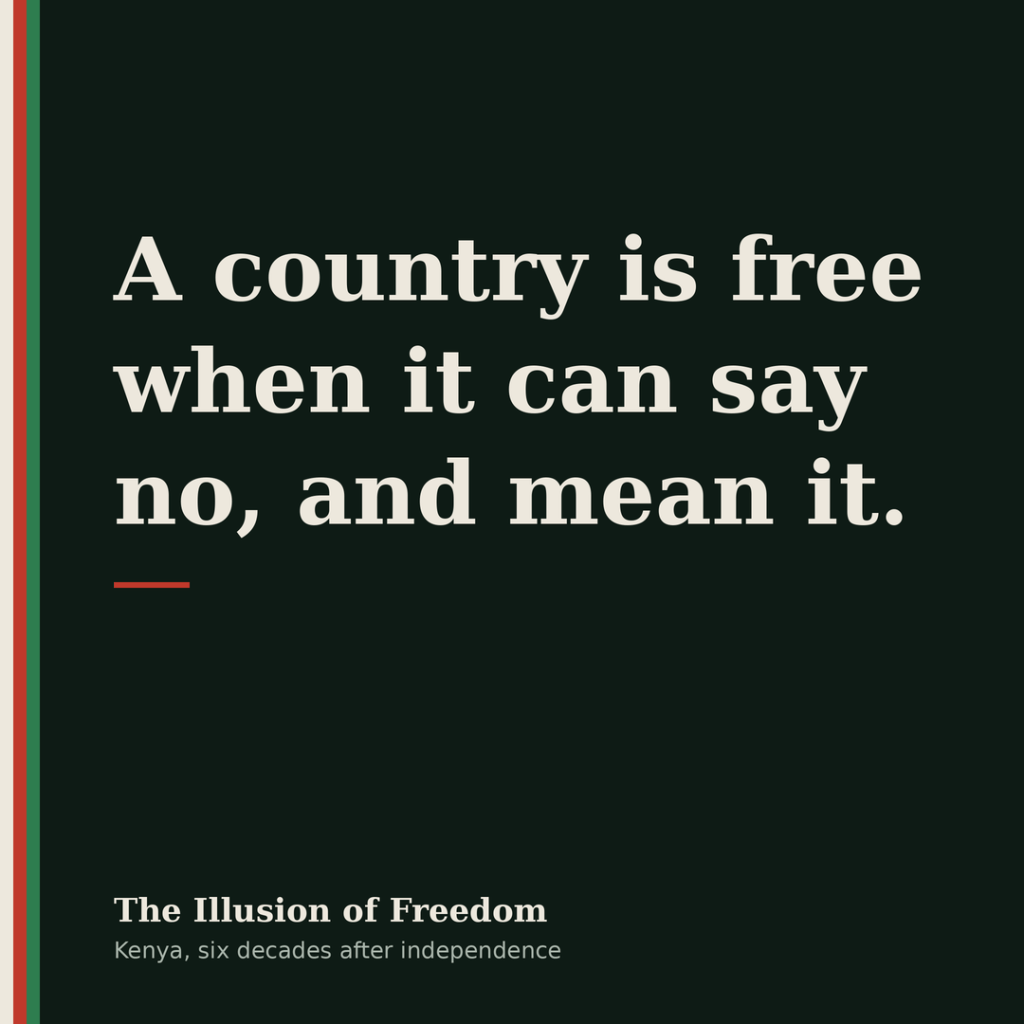
A country is free when it can say no, and mean it. That requires:
- Transparent contracts that citizens, journalists, and parliament can read.
- Local value addition, so Kenya sells finished goods and not only raw materials.
- Lower dependence on debt, through stronger domestic revenue and smarter spending.
- Regional strength, bargaining through the East African Community and the African Union as a bloc.
- Leaders accountable to citizens before creditors.
So, Is Freedom an Illusion?
Illusion may be too harsh. The freedoms Kenyans have won are real: to speak, to organise, to vote, and to demand better. But the illusion lies in believing that formal freedom equals real freedom. A flag, a constitution, and an election calendar are the beginning of freedom, not the end.
Freedom is a fair price for food, a clinic that works, a harvest that survives the season, a job that pays, and a leader who answers to the people. And it is the ability to sit across the table from any power, whether London, Washington, Beijing, the Gulf, or Brussels, and negotiate as an equal.
Independence was a promise. Our task is to demand that it be kept, not through nostalgia or cynicism, but through informed, persistent citizenship.
My Take
When we talk about freedom as a country, we have to ask ourselves: from what, from whom, and why do we want it? We have a country full of educated young people, and the parents are well informed, but the problem is that, with all the knowledge we have, we cannot work together to save ourselves from the hands of the colonisers; everyone thinks they are right and their opinions should be accepted. As a Kenyan, the hard truth I have learned is that we have never voted for anyone since we got “independence. All the elected members are people planted by the colonisers who control the country; the British, Americans, Israelis, Arabs, Chinese, and Europeans are the real owners of the country; we are just commodities, and our politicians are the colaborators/ managers. I have listened to many people talk; I have read articles; I have listened to podcasters and influencers, and most of them have varied points. But my concern is that they are simply playing the game the colonisers want them to play. The problem in Kenya is not the president or any elected member or government official; the problem is simply ethics, morals, values, unity, identity, and the understanding of how things really operate. You can vote or not vote, but the outcome will be the same because we were never free as a country; we are still being colonised. If Kenyans want change and freedom, they have to cut the colonial rope that is strangling them.
What does freedom mean to you? Share your thoughts in the comments.


Leave a Reply